Tuesday, September 2, 2014

Arboretum Photos Part 3

During the past six years as a birder, my interests in butterflies, dragonflies, and other animals have grown. This seems to be common among conservationists, as an interest in one area often sparks interests in others. I love birds personally! Insects, especially butterflies, are a growing interest however. Guides, books, and hobbyists all seem to gear toward this overlap.

Similar to my past with birds, I am learning how to identify species by taking pictures and studying them at home. Below are select insect photos I've taken over this past month at the Overland Park Arboretum. You can click on each of them to see larger, more detailed versions. The Arboretum is fairly close and has become a common photo destination for me individually and with the family

Skippers are currently my favorite family of butterflies. They exhibit quick, darting flight are usually fairly small and orange or brown in color. Some species prefer to rest with their wings shut while others rest with wings perfectly flat or partially spread.
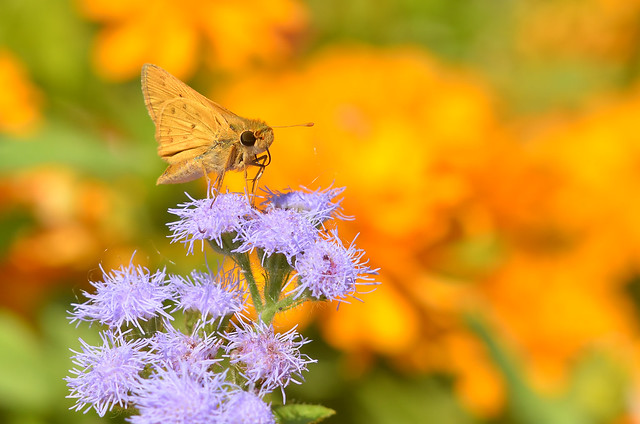
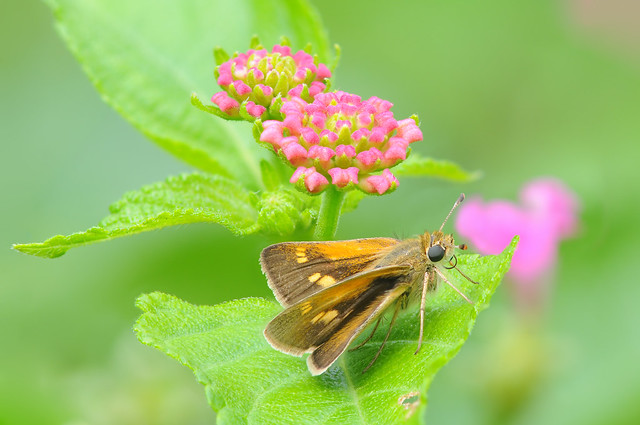
Fiery Skipper 2   Tawny-edged Skipper (Female)
The Fiery skipper (left) and Tawny-edged skipper (right) often rest with wings together.
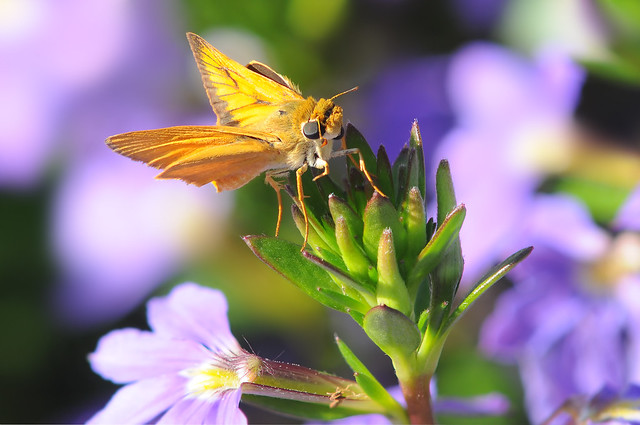
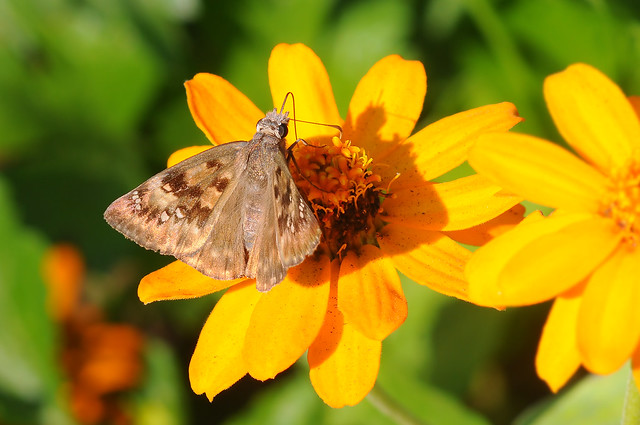
Delaware Skipper   Juvenal's Duskywing 
The Delaware skipper (left) and Horace's Duskywing (right) hold their wings differently at rest.

Unlike most bird species, many insects are well-behaved photography subjects and remain fairly still. They also tend to stick around in the same general area rather than flying away. Having stationary objects allows me to practice photography techniques in addition to studying the species. One technique I attempt to increase sharpness and appearance of digital photos is focal stacking, where multiple images are merged together.  Essentially it takes the good portions of each photo to make one master composite that is better than each of the individual pieces. This technique is particularly useful with macro photography where a small subject is close to the camera. This technique allows for great detail by overcoming the limits of normal lenses. The Eastern-tailed Blue photo below is an example where I used focal stacking as one frame did not have the tip of the flower, tip of the antenna, wings, tail, eye, or flower pedal all in focus. Instead I used 10 different photos and put them together in the digital darkroom. 
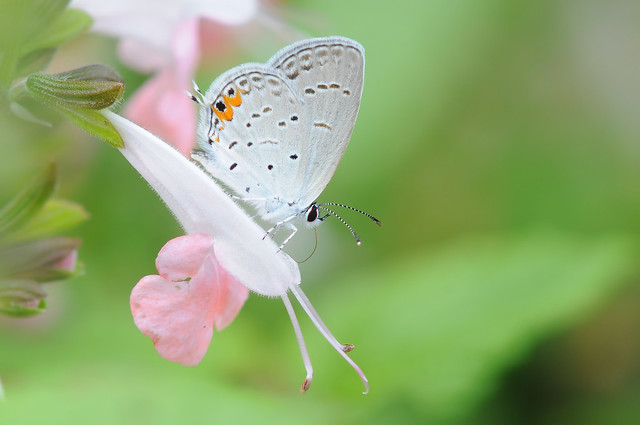
Eastern Tailed-Blue

Brush footed Butterflies are a diverse family of butterflies named for the adult butterfly's front pair of legs that are modified into two small "brushes". This family is one that often draws my attention with their color and size.
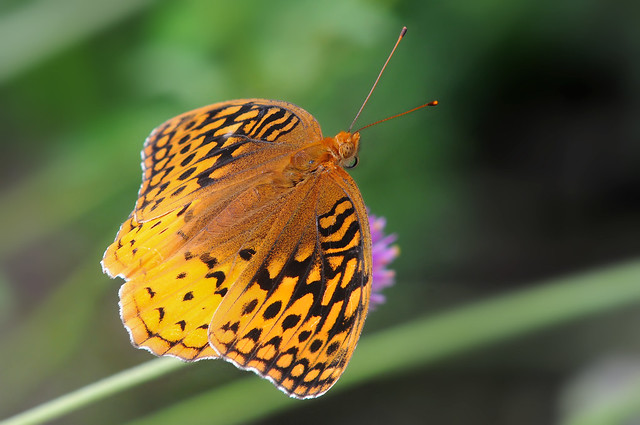
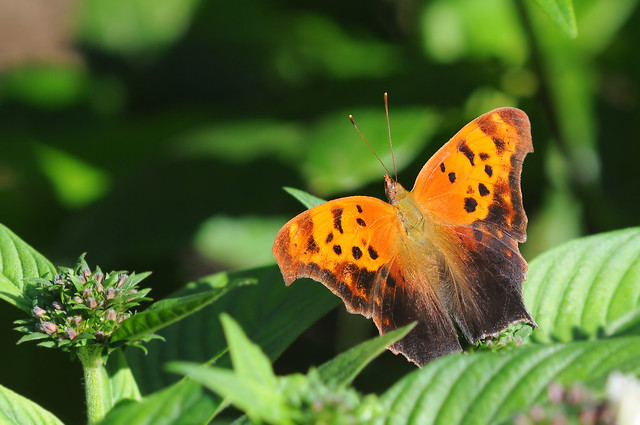
Great Spangled Fritillary   Question Mark
The Great Spangled Fritillary (left) and Question Mark (right) are species within this family.

This Painted Lady was seen on Sunday of this past weekend after watching a juvenile Green Heron. The other butterfly photo from that excursion was the above Fiery skipper.
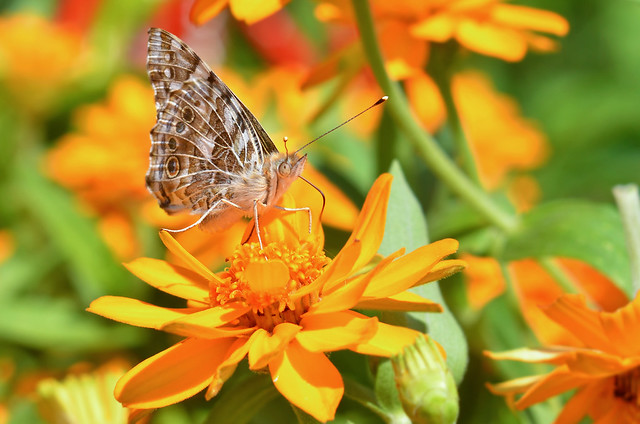

Painted Lady

In my search for butterflies, other species and families often appear. The Snowberry Clearwing is a member of the sphinx moth family with big and sometimes colorful relatives. The girls often think they are bees at first based on color and size. Sphinx moths appear to dart in and out of flowers like hummingbirds as well, and are a joy to watch. Capturing a sharp photo of anything in flight remains elusive and seems to be a challenge requiring more time.  
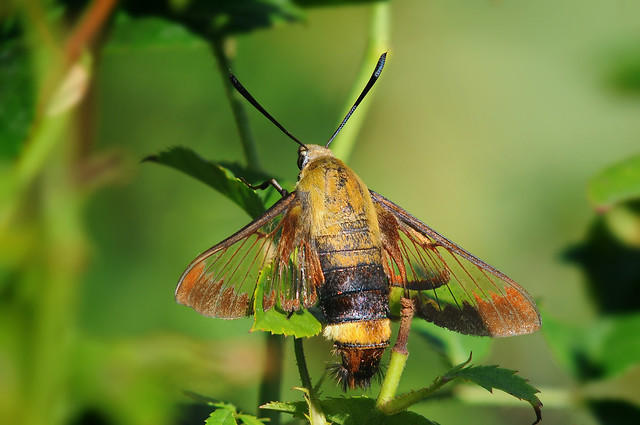
Snowberry Clearwing

Someday I'll expand my quests outside of Lepidoptera (Moths and Butterflies), but so far I have limited experience and photographs. Dang spiders seem cool!
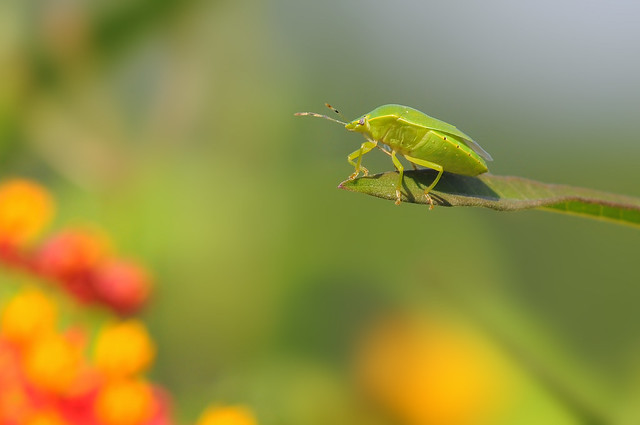
Green Stink Bug
This Green Stink Bug walked to the edge of the leaf and paused before taking flight.

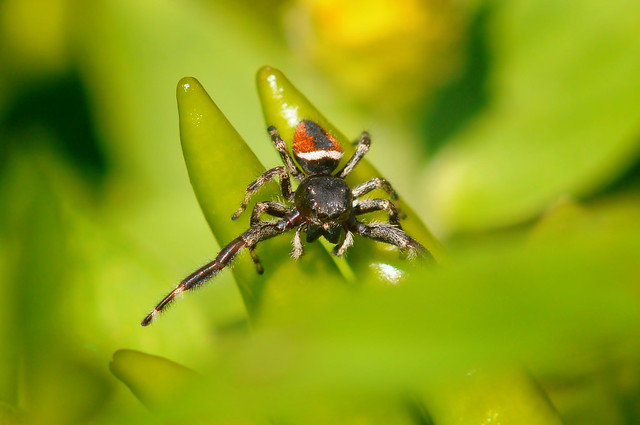
I need some help identifying this species.  I believe it is a male Jumping Spider of some sort. (Phidippus clarus)
While butterflies receive much attention due to color, other families receive much less.
This Jumping Spider may be Phidippus clarus.

Monday, September 1, 2014

Arboretum Photos Part 2

After the families quick visit to the Arboretum on Saturday, I went back Sunday afternoon with hopes of photographing insects. I brought a manual focus macro lens that I've been using the past month. The macro lens allows me to get quite close to insects, but is tough to get accurately focused and almost impossible to use with moving subjects. For some reason I grabbed two cameras rather than one however. In addition to the previously mentioned camera I brought another with a 80-200 mm auto-focus lens.  The 80-200 lens is a shorter focal length (not as much magnification) than the 300 mm lens we use for taking pictures of birds, but as it turns out was perfect for what was to happen.

After arriving I walked the path towards the western gardens, but something caught my eye. A bird was walking along the shore and I hoped that if I sat still on the bridge, perhaps it would get closer.  I was very fortunate to have a raccoon walk right up to me using a similar sit and wait method last year.  Shortly after sitting down the bird appeared. Do you see it in the photo below?  

I'm hiding, you aren't supposed to see me!

The camera's shutter sound drew the heron's attention toward me. I didn't know if this juvenile Green Heron would continue in the same direction or turn around after spotting me. After a few anxious minutes, it started walking towards me again.  My heart was beating hard with excitement as I took many photos. 

  
Green herons are larger than perching birds. They can stretch to 18 inches and look at those feet.  

As the heron stepped out into the sun I was ecstatic to have an auto-focus lens on a camera. With the sun over my shoulder and close proximity, this was the best photo opportunity of a Green Heron in quite a few years.  While walking you can approach them, but they usually fly before letting you get nearly this close. 


With hopes that the above portrait was properly exposed and tack sharp on the memory card, I realized that this Green Heron had walked so close that I should zoom back the lens.  At 200 mm (about 4 time magnification) the heron barely fit in the frame. As soon as I zoomed back, the heron turned and started back in the direction he came.  I was happy for the experience but sadden with the possibility that it had ended so soon. Luckily, the change in direction was only because it spotted something to hunt!

 
The stalk and extension.

I watched the hunt through the lens, so some of the details were tough to take in as it happened.  But I was very excited to see what it had caught in the photos.  This little fish was in the wrong spot at the wrong time. 


After successfully catching the above morsel the Heron preened and satisfied an itch.  It stretched its wings and gave a good shake, and even appeared to lick its bill.  Then it went on another hunt, but this time for a different prey. 

 
Do you see the male blue damselfly on the stick?

The Heron spotted a small damselfly and had no problem catching it. The age of the bird showed itself however, as it tossed its dead prey in the air twice to maneuver it and dropped it in the water in the process. 


I felt truly blessed, as I was fortunate enough to watch this young heron successfully catch a fish and damselfly. But what happened next shocked me, as it turned to me and walked right toward me. I had never heard of a green heron attacking a person, so I confidently sat still with each step. I was very thankful for having a zoom lens now, as the the last two pictures below are taken at approximately 80 mm.  This is roughly a two power magnification, or twice the size of eyesight. After snapping the last picture I put the camera down to see the heron studying me from about 6 feet.  What a photo excursion!

This odd angle makes me image a completely different looking bird.

The heron's tongue appeared again while walking down the log.

He sat motionless for 10 seconds, before quickly walking across the bridge and  returning to the pond.

While I had no intention of taking bird photos on this particular day, I ended up with a memory card full of this juvenile green heron and this wonderful 15 minute experience. I did find a few cooperative butterflies, but those photos will have to wait until another post. 

Sunday, August 31, 2014

Arboretum Photos Part 1

A 3rd Nikon DSLR for us, photo from last month!!
It is somewhat crazy how one's own decision making easily changes. Take for instance this weekend. 

I often intend to spend time in nature aware of my surroundings, studying my surroundings, and opening my senses to the experiences around me. Other times I chase a reported bird sighting, where it may be the first time I've seen that species or one I've seen before but am interested in seeing again. Less often I target specific bird species by searching appropriate habitat, or lastly I grab a camera with hopes of catching a good photo or two.  Many of those reasons disappear partially or completely when the girls are with. 

This Labor Day weekend I asked the girls to complete a rainbow challenge. The intent was to have the take a photo of an animal of each color of the rainbow. We returned to the Overland Park Arboretum in search of the birds, insects, reptiles, arachnids, and amphibians variety we had seen earlier this summer. Before we left the car however, the girls had decided it would be too tough to find anything purple or blue, and instead modified their challenge to find five different colors. They were great sports and spent the better part of an hour in their search.

I'm not sure what she was taking a picture of here.

Below are Danielle's photos.


Ruby-throated Hummingbird and a Painted Lady, species from my two favorite classes of animals.
    
Three Skipper sp. butterfly photos.
A Cricket Frog and Grasshopper sp. from the sidewalk.
  
A Fly (Villa Sp) and Arachnid (Harvestman sp perhaps Leiobunum vittatum)
Christine pointed out this hiding Five-lined skink (Plestiodon fasciatus) to Danielle. 

Below are Michaela's photos.


The Goldenrod Soldier Beetles (Chauliognathus Pennsylvanicus) were everywhere, as were ants.
    
A Black-legged Meadow Katydid and two Skipper Butterfly species.
  
A Cabbage White Butterfly and another visitor to the Hummingbird feeder.

It is fun to watch the girls notice things, slow down to take pictures, and to look through them on the computer afterwards.  Their perspective is quite different than mine. I did not get many photos on this day, beyond the one below. I did not quite get my fill of the surroundings either, but I can always go back again for myself.

Friday, August 1, 2014

King Tut Exhibit

When we got to king Tut mom asked "Was it you or Danielle that thought they wouldn't like King Tut?"  I said, "Danielle".  When we got there asked "Can we go see something different?" Then Dad and Danielle went downstairs and we got headphones that tell you about King Tut as we walked through (the exhibits). 
Then we went to a show that tells you about King Tut and the people who found where the mummy of King Tut was buried.  (Carter) looked for a long, long, long time before they found the treasure and mummy. 
All of the rooms were mostly filled with gold to help the King after he was dead.  He was buried deep, deep, deep in the ground.  They had to take off a bunch of coffins because he was buried inside all of them.  Then they put it on a boat that was on the Nile River to go to the museum.
They found more than one treasure! 


Tuesday, July 29, 2014

Our Trip to the Arboretum

When we got to the arboretum, Dad told me to take pictures of 5 different butterflies.  Right when Dad told me, Mom saw a spider which I took pictures of.  Then there were more on the other side.  


The first butterfly I saw was white.  


We saw a fairy garden in a log and Dad said I think those are termites eating that.


The second butterfly was orange and I saw a bunch of bumblebees.  


I found a blue butterfly and took a couple of pictures.


We saw a moth that curled its tongue, that was very cool.  The moth looked like a hummingbird and kinda like a moth.  He was very big. 

White-lined Sphinx Moth


Mom thought she saw a snake, but someone else told it us it was a blue-tailed skink. We saw one hiding in the rocks later.  


I saw a another orange butterfly, Dad thinks it is pearl crescent but is not sure.  


Dad saw a damselfly, Danielle said "That's a dragonfly" but I told her it was a damselfly.  Mom saw a dragonfly, and I said "Is it alive?"  Mom said I don't think so.  Then we saw ants eating it.


Mom saw a very cool plant that had little lines going down from it with a big ball on top.


Mom saw a blue-tailed skink that's tail had fell off. I saw a dragonfly by it.


I tricked Dad by saying "I see a big dragonfly", but it was just a bench. 

Mom showed me a grasshopper, nobody else saw it. I said where is it, then mom showed me.

I saw a grasshopper when Mom told me to take a picture of a dragonfly.


I saw a grasshopper nobody else saw.


Dad pointed to a dragonfly on a log in the pond and it was in the middle on the way back.


Mom saw a red bug, nobody knew what kind it was.  


Malcolm writing now, below are other photos that Michaela wanted to include in this blog post even though they did not fit with her story. 


Michaela took over 300 photos today, including one of us.